Starting a Box Truck Business: The First 90 Days

The short answer
The first 90 days of a box truck business are not about finding the perfect load board or the cheapest fuel card. They are about three things done in the right order: deciding whose authority the truck runs under, getting the paperwork for that path finished before the first dispatch, and keeping enough cash on hand to survive the gap between the first load and the first payment.
This guide is for someone who already has the truck, or is about to sign for it. It walks through the first three months in 30 day blocks. Where the federal rules decide what you must do, we link to the rule itself so you can read the exact wording instead of a summary.
The first decision: your own MC or a carrier’s
Everything else in the first 90 days depends on one choice. You can register your own operating authority and haul as a carrier in your own name, or you can lease your truck to a carrier that already has authority and haul under theirs.
Running under your own authority means you are the motor carrier. You hold the registration, you buy and file the insurance, you answer to the safety audit, and you find and bill your own freight or pay someone to do it. You keep the full rate on every load, and you carry the full risk of every load.
Running under a carrier’s authority means the carrier is responsible for the operating authority and its filings, and you work as a leased owner-operator. You give up part of the gross in exchange for freight, dispatch and a compliance structure that already exists. The truck is still yours, and so are its costs.
Neither path is better for everyone. Our guide on whether you need your own MC authority lays out the trade in detail. Make this call first, because the next 30 days look very different on each side of it.
Days 1 to 30: setup before the first load
The goal for the first month is simple: nothing on the truck should be missing on the day it is dispatched. Here is what that list looks like on each path.
If you are getting your own authority
Registration. Federal law lets FMCSA register a for-hire carrier only if it is willing and able to comply with the safety regulations and the other requirements in the statute (49 U.S.C. 13902(a)(1)). In practice that means applying, getting a USDOT number and MC number, and then waiting for the authority to become active. You cannot haul for-hire interstate loads on a pending application.
Process agents. A carrier has to designate an agent in each state where it operates, in writing, filed with the Department of Transportation (49 U.S.C. 13304). Most new carriers use a blanket process agent service that covers every state at once.
Insurance on file. FMCSA may register a carrier only if it files an approved insurance policy, bond or other security, and the registration stays in effect only while that security is maintained (49 U.S.C. 13906(a)(1)). For a for-hire interstate carrier hauling general freight in a vehicle rated at 10,001 pounds or more, the federal minimum is $750,000 in public liability (49 CFR 387.9), and no carrier may operate until it has that coverage in place (49 CFR 387.7). Our insurance cost guide covers what the policies are and what moves the premium.
Unified Carrier Registration. Interstate carriers also register and pay a yearly fee under the UCR agreement, which is set out in 49 U.S.C. 14504a. The fee is set in brackets by fleet size, so check which bracket your truck count falls in when you register.
If you are leasing onto a carrier
The application and the lease. The carrier will ask about your truck, its year, and your driving record, then put a written lease in front of you. Federal leasing rules require the pay to be clearly stated on the face of the lease or in an attached addendum, delivered to you before the first trip, and they require the lease to say when you get paid after you hand in your delivery paperwork (49 CFR 376.12). Read the deductions and the termination clause before you sign. Our guide to owner-operator contracts lists what to check line by line.
Who insures what. On a lease, the carrier’s filing covers its authority, but you will usually still carry your own physical damage coverage on the truck and often non-trucking liability. Ask in writing which policies the carrier holds and which ones you need before the first load.
On both paths
The driver. In interstate commerce, a truck rated at 10,001 pounds or more is a commercial motor vehicle (49 CFR 390.5), and its driver needs a valid medical examiner’s certificate (49 CFR 391.41). That applies even when the truck is light enough to drive without a CDL. Our non-CDL box truck guide covers where the CDL line falls and what still applies below it.
The truck. A commercial motor vehicle must pass a periodic inspection at least once every 12 months, and proof of that inspection has to be on the vehicle (49 CFR 396.17). If you bought the truck used, do not assume the seller’s inspection is current. Get your own done and keep the paper in the cab.
The business. Set up the business entity you plan to use, a separate bank account, and an Employer Identification Number. The IRS issues an EIN online for free, and it warns against websites that charge for one (IRS: get an EIN).
Got the box truck but not the authority yet?
Apply with Suntrans and choose your path on the form: run under SuntransExpress authority, or keep your own MC and haul our freight.
Days 31 to 60: first loads and first habits
The second month is when the truck starts moving and the habits that will run the business get set.
Finding freight. On your own authority, your first loads will likely come from load boards, brokers who will work with a new MC, and any direct shippers you already know. Under a carrier, the carrier’s dispatch is your main source, which is a large part of why drivers choose that path. Our guide on where box truck and cargo van loads come from compares the sources.
Paperwork per load. For every load, keep the rate confirmation, the signed bill of lading or proof of delivery, fuel receipts and any lumper or detention records together. If you are on a lease, your payment timing is tied to handing in those delivery documents, so slow paperwork means slow pay. If you are on your own authority, missing paperwork means invoices that get short paid or disputed.
Know your cost per mile. After the first few weeks you have real numbers: fuel, insurance, the truck payment and maintenance divided by the miles you actually ran. Compare that to what the loads paid. If loaded miles do not cover your costs plus the empty miles to reach them, no amount of extra driving will fix it.
Inspection readiness. Roadside inspections start counting against a new carrier right away. Do a walk around before every trip, fix lights and tires before they are written up, and keep your medical card, registration, inspection proof and insurance papers where you can hand them over in seconds.
The cash gap nobody plans for
The most common way a new box truck business fails in the first 90 days is not a bad load. It is running out of cash while the money for good loads is still on its way.
On your own authority, a broker typically pays on terms that can stretch weeks past delivery unless you use quick pay or a factoring company, and both of those cost a percentage of the invoice. Meanwhile fuel, insurance installments and the truck note are due on their own schedule. Under a carrier, the payment period is written into the lease, which makes the gap shorter and easier to predict, but it does not make it zero. The first settlement still arrives after the first week of work, not before it.
Plan for the gap before the first load: know how many weeks of fixed costs and fuel you can carry with no revenue coming in, and do not spend that reserve on upgrades. Our guide to the first six months of a Sprinter van business breaks down the payment gap and monthly burn in detail, and the same logic applies to a box truck with bigger numbers on every line.
Days 61 to 90: the audit window and your first tax quarter
By the third month the business is running, and two things you may not have thought about since day one come due.
The new entrant safety audit. If you hold your own authority, you are a new entrant for 18 months. FMCSA monitors your roadside performance during that period and conducts a safety audit once you have been operating long enough to have records to review, which the rule says will generally be at least 3 months (49 CFR 385.307). In other words, the audit can land right around the end of your first 90 days. Certain events move it up: for example, a driver or vehicle out-of-service rate of 50 percent or more based on at least three inspections in a consecutive 90 day period, or operating without the required insurance (49 CFR 385.308). Our new entrant safety audit guide covers what the auditor checks and how to prepare. If you are running under a carrier’s authority, the audit is the carrier’s, but your inspections and records still feed into it.
Estimated taxes. Nobody withholds tax from owner-operator income. The IRS describes Form 1040-ES as the way to pay tax on income that is not subject to withholding, with self-employment earnings as the first example (IRS: About Form 1040-ES). Your first quarterly payment may come due inside your first 90 days. Set aside a share of every settlement or invoice from the start, and talk to a tax professional about what is deductible. Our guide on owner-operator tax deductions is a good place to start that conversation.
Review the numbers. At day 90 you have a full quarter of data. Look at revenue per week, cost per mile, empty miles, how long payments took, and how much of the cash reserve is left. That review is how you decide whether to stay on your current path, switch from a lease to your own MC, or go the other way.
Common mistakes in the first 90 days
Buying the truck before choosing the path. The truck you can afford, the insurance you need and the freight you can get all depend on whose authority you run under. Decide that first.
Booking loads before the authority is active. An application is not authority. Hauling for-hire interstate freight before your registration and insurance filing are in effect puts both the load and the business at risk.
Signing a lease without reading the deductions. The gross rate on a lease means little until you know what comes out of it. Ask for the full list of chargebacks in writing.
Letting paperwork pile up. Delivery documents drive your pay, and records drive your audit. Both reward the driver who files them the same day.
FAQ
Do I need my own MC number to start a box truck business? Not always. You can register your own authority, or you can lease your truck onto a carrier and run under its authority. The right choice depends on your cash, your freight contacts and how much of the compliance work you want to carry yourself.
How long does it take before a box truck business makes money? It depends on your costs, your rates and how fast you get paid, so there is no single number. What is predictable is the gap: expect to pay at least a few weeks of fuel and fixed costs before the first payments arrive, and plan your reserve around that.
When does the new entrant safety audit happen? FMCSA conducts it once a new carrier has enough operating records, which the rule says will generally be at least 3 months into the 18 month monitoring period. Some events, such as a high out-of-service rate or operating without required insurance, can bring it forward.
Does a non-CDL box truck still need a medical card and inspections? If the truck is rated at 10,001 pounds or more and runs in interstate commerce, it is a commercial motor vehicle under federal rules. That brings in the driver medical certificate and the annual inspection even when no CDL is required.
Can I start under a carrier and get my own authority later? Yes. Some owner-operators learn their real costs under a carrier first, then apply for their own MC once the numbers work.
What this looks like at SuntransExpress
SuntransExpress works with cargo van, Sprinter and box truck owner-operators on both paths. On our owner-operator page you can run under SuntransExpress authority or keep your own MC and haul our freight, and an own MC is not required in many programs. Owner-operators get weekly pay and 24/7 dispatch support.
The application asks for your equipment type, the vehicle year and whether you have your own authority, so you can apply with the box truck you already have. Questions before you apply can go to hr@suntransexpress.com or +1 (941) 337-52-33.
Got questions about running with us? Dispatch will walk you through it — no pressure, no obligation.
Talk to us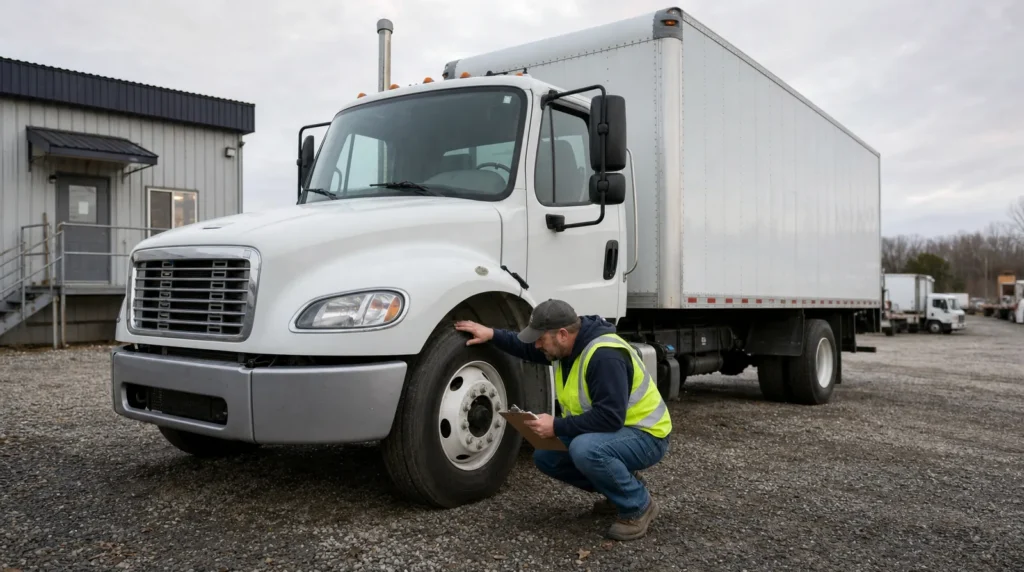
New Entrant Safety Audit: What a First Year Carrier Gets Checked On
What the FMCSA new entrant safety audit checks in your first 18 months under your own authority, the 16 violations that fail it, how…
Read the guide →
Cargo Van, Sprinter and Box Truck Owner-Operator Jobs: What the Posting Leaves Out
What a cargo van, Sprinter or box truck owner-operator posting leaves out: pay basis, whose authority, insurance, escrow and charge-backs, deadhead and detention, and…
Read the guide →
Box Truck and Cargo Van Loads: Where Owner-Operators Find Freight
Where box truck and cargo van freight actually comes from: load boards and what their tiers include, posting your truck, checking brokers against the…
Read the guide →Ready to get on the road?
Weekly pay, 24/7 dispatch support, and nationwide expedited loads — with or without your own MC authority.