DOT Inspection Levels Explained for Box Truck and Van Owner-Operators
The short answer
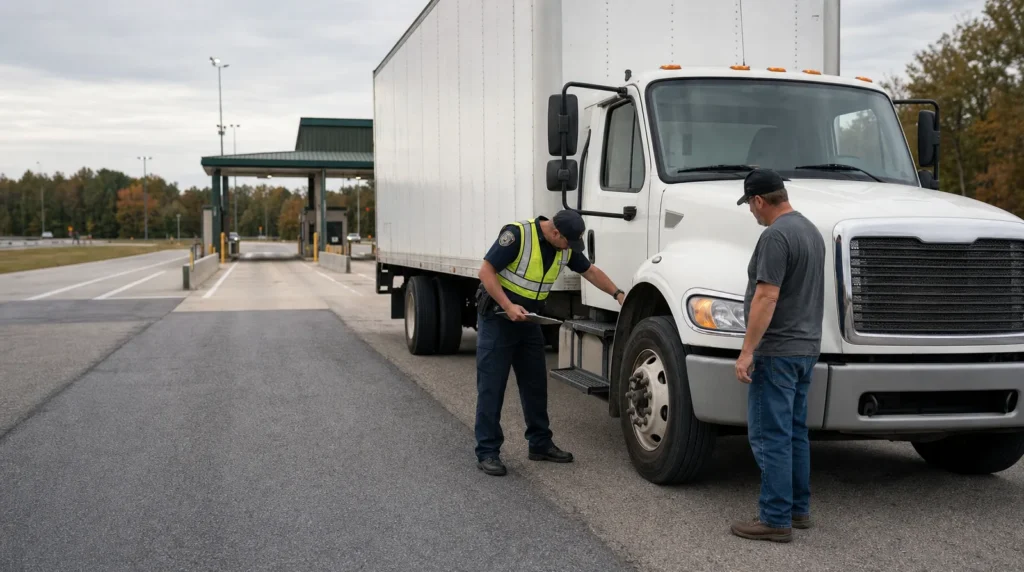
A DOT inspection level tells you how much of the driver and the vehicle an officer checked at a roadside stop. The levels are part of the North American Standard published by the Commercial Vehicle Safety Alliance. Level I is the full inspection of the driver’s documents and the vehicle. Level II covers the same list, limited to what can be checked without getting under the vehicle. Level III checks the driver and the paperwork only. Level V is the full vehicle check with no driver present. The other levels cover special studies, radioactive shipments, local programs, electronic checks and crashes.
For a box truck or a van owner-operator, two questions matter more than the level number: whether your vehicle is a commercial motor vehicle under the federal rules at all, and what happens to your record after the officer hands you the report. This guide covers the levels, how they apply to your vehicle, what an out-of-service order means, and how the results follow you.
The inspection levels, one by one
The definitions below come from the CVSA list of all inspection levels. Item lists are shortened; the full wording is on the CVSA page.
- Level I, North American Standard Inspection. The full inspection. On the driver side it covers the driver’s license, the Medical Examiner’s Certificate, alcohol and drugs, the record of duty status, hours of service, the seat belt and vehicle inspection reports. On the vehicle side it covers brake systems, cargo securement, coupling devices, driveline, exhaust, frames, fuel systems, lighting, steering, suspensions, tires, “van and open-top trailer bodies”, wheels, rims and hubs, and windshield wipers.
- Level II, Walk-Around Driver/Vehicle Inspection. The same items as a minimum, but CVSA notes it is “contemplated that the walk-around driver/vehicle inspection will include only those items that can be inspected without physically getting under the vehicle.”
- Level III, Driver/Credential/Administrative Inspection. The driver’s license, Medical Examiner’s Certificate, record of duty status, hours of service, seat belt, vehicle inspection reports, “and carrier identification and status.” CVSA adds that mechanical violations from a Level I or II “should not be included in a Level III Inspection.”
- Level IV, Special Inspections. Typically “a one-time examination of a particular item”, made “in support of a study or to verify or refute a suspected trend.”
- Level V, Vehicle-Only Inspection. Every vehicle item from Level I, “without a driver present, conducted at any location.”
- Level VI, radioactive shipments. An inspection for transuranic waste and highway route controlled quantities of radioactive material, built on Level I with added radiological requirements.
- Level VII, Jurisdictional Mandated Commercial Vehicle Inspection. A program a state or province requires that does not meet any other level. CVSA’s examples include school buses, limousines, taxis and hotel shuttles.
- Level VIII, North American Standard Electronic Inspection. An inspection “conducted electronically or wirelessly while the vehicle is in motion without direct interaction with an enforcement officer.” The data points include the driver’s license class and status, the medical certificate, the record of duty status, hours-of-service compliance, the USDOT number, power unit registration, operating authority, Unified Carrier Registration compliance and federal out-of-service orders.
- Level IX, Post-Crash Inspection. Conducted after a crash with a fatality, serious physical injury, a high-profile crash involving a commercial motor vehicle, or where the jurisdiction requires it. It “must include all accessible inspection items in a Level I Inspection Procedure.”
One detail in the Level I definition shows how strict the line between levels is: if more than 20 percent of pushrod travel on exposed pushrods cannot be measured, CVSA says the inspection “would not be considered a Level I Inspection and shall be identified as a Level II Inspection.”
How the levels apply to a box truck or a van
Roadside inspections under the federal safety rules are aimed at commercial motor vehicles. Whether your vehicle is one depends on its weight rating and what it carries, not on whether it is a truck or a van. Under 49 CFR 390.5, a commercial motor vehicle is a vehicle “used on a highway in interstate commerce to transport passengers or property” when it has a gross vehicle weight rating or gross combination weight rating, or actual weight, “of 4,536 kg (10,001 pounds) or more, whichever is greater”. A vehicle hauling hazardous material in a quantity that requires placards is a commercial motor vehicle at any weight.
- Box truck. Check the GVWR on the vehicle’s label. If it is 10,001 pounds or more and you haul across state lines, the truck is a commercial motor vehicle under this definition, and the levels above can apply to you. On a box truck, “van and open-top trailer bodies” and cargo securement are on the Level I list next to brakes, lights and tires.
- Cargo van or Sprinter. A van under 10,001 pounds GVWR hauling general freight falls outside the weight part of this federal definition. A heavier van configuration does not. Check the rating on your own vehicle rather than the model name, and check your state’s rules if you also run intrastate.
The same definition decides whether the annual inspection covered below applies to you. Our guide to running a non-CDL box truck legally covers what a truck under 26,001 pounds still needs.
Two items on the Level I list are worth preparing for in advance, because you control both. The first is the annual inspection. Under 49 CFR 396.17, a motor carrier “must not use a commercial motor vehicle” unless each listed component “has passed an inspection in accordance with the terms of this section at least once during the preceding 12 months and documentation of such inspection is on the vehicle.” The second is the driver paperwork: license, medical certificate and record of duty status, which appear on Levels I, II, III and VIII.
Running a box truck or van and looking for freight?
Apply with SuntransExpress and choose your path on the form: run under SuntransExpress authority, or keep your own MC and haul our freight.
What an out-of-service order means
Any level can end with an out-of-service order on the driver, the vehicle or both. The federal definition in 49 CFR 390.5 calls it “a declaration by an authorized enforcement officer” that a driver, a commercial motor vehicle, or a motor carrier operation is out of service, under the federal rules or “the North American Standard Out-of-Service Criteria.”
For the vehicle, 49 CFR 396.9 sets the rules:
- An officer marks out of service any vehicle “which by reason of its mechanical condition or loading would likely cause an accident or a breakdown”, using an “Out-of-Service Vehicle” sticker.
- Nobody may operate it “until all repairs required by the ‘out-of-service notice’ have been satisfactorily completed.” Towing counts as operating, except that the vehicle “may be towed away by means of a vehicle using a crane or hoist.”
- “No person shall remove the ‘Out-of-Service Vehicle’ sticker” before those repairs are done.
For a load on a deadline, this is the part that costs money: the truck stays where it is until it is fixed, and the freight is late.
What to do with the inspection report
Whatever the level and the result, the report has steps attached under 49 CFR 396.9:
- Hand it over. The driver delivers a copy to the motor carrier operating the vehicle at the next terminal or facility. If the driver is not due there within 24 hours, the driver “shall immediately mail, fax, or otherwise transmit the report”.
- Fix and sign within 15 days. Within 15 days of the inspection, the motor carrier must certify “that all violations noted have been corrected” by signing the carrier portion of the form.
- Send it back if asked, and keep it. Return the form to the issuing state agency if it asks, and in all cases keep a copy for 12 months from the date of the inspection.
Who does this depends on how you run. If you are leased onto a carrier, the report goes to that carrier and it handles the certification. If you run under your own MC, you are the motor carrier, and the 15 days are yours to meet.
How inspections feed your safety record
Inspection results do not end at the roadside. FMCSA’s Safety Measurement System “uses data from roadside inspections and crash reports from the last two years, and data from investigations” to identify carriers for intervention. It is updated once a month and sorts the data into seven categories called BASICs, among them Vehicle Maintenance, Hours-of-Service Compliance and Driver Fitness.
FMCSA notes that violations on a roadside inspection report “are used in the SMS, regardless of whether a State officer also issues a citation (i.e., ticket) or a verbal warning.” A stop that ends with only a warning can still put violations on your record if they are written on the report. If you believe a violation on a report is wrong, FMCSA says drivers and carriers “can request a review of the data through DataQs.”
This weighs most on a new carrier, whose first inspections are a large share of a short record. Our guide to the new entrant safety audit covers how out-of-service results count in the first 18 months. The same inspection data is what a driver sees when checking a carrier before signing on, as set out in our guide on how to check an expedite carrier.
FAQ
What is a Level 1 DOT inspection? The full North American Standard Inspection: the driver’s documents, hours of service and seat belt, plus the vehicle’s brakes, cargo securement, lights, steering, suspension, tires, wheels, body and the other items on the CVSA list.
What is the difference between a Level 1 and a Level 2 inspection? Level II covers the same items as a minimum, but as a walk-around, limited to what can be inspected without getting under the vehicle.
Can a cargo van get a DOT inspection? A van is a commercial motor vehicle under the federal definition in 49 CFR 390.5 if it is used in interstate commerce and has a GVWR or actual weight of 10,001 pounds or more, or carries placarded hazardous material. Check the rating on your own van and your state’s rules for intrastate work.
How long do I have to fix violations on an inspection report? Under 49 CFR 396.9, the motor carrier has 15 days from the inspection to certify that the violations were corrected. A vehicle placed out of service cannot be driven until the required repairs are done.
Do violations count if I did not get a ticket? Yes. FMCSA says violations on a roadside inspection report are used in the Safety Measurement System whether or not a citation or a verbal warning was also given. The system uses inspection data from the last two years.
What this looks like at SuntransExpress
SuntransExpress works with cargo van, Sprinter and box truck owner-operators on two paths, as set out on our owner-operator page: run under SuntransExpress authority, or keep your own MC and haul our freight. The page lists weekly pay and 24/7 dispatch support, and notes that your own MC is not required in many programs.
Under your own MC, you are the motor carrier on an inspection report and the 15-day certification is yours. Under a carrier’s authority, the report goes to that carrier. The application asks for your equipment type, the vehicle year and whether you have your own MC authority, so you can tell us which path fits before we call you with loads. Questions before you apply can go to hr@suntransexpress.com or +1 (941) 337-52-33.
Got questions about running with us? Dispatch will walk you through it. No pressure, no obligation.
Talk to us
Recourse vs Non-Recourse Freight Factoring
How freight factoring works for van and box truck owners on their own MC, what recourse and non-recourse really cover, and the contract clauses…
Read the guide →
Rate Confirmation: What to Check Before You Haul the Load
A four-pass check of a broker's rate confirmation for van and box truck owners with their own MC: the sender, the load, the money…
Read the guide →
Lumper Fees: Who Pays, and How Owner-Operators Get Reimbursed
Who owes a lumper fee under federal law, how it gets paid at the dock, and the receipt and paperwork you need to get…
Read the guide →Ready to get on the road?
Weekly pay, 24/7 dispatch support, and nationwide expedited loads, with or without your own MC authority.