UCR Registration for Small Carriers: Who Files, What It Costs, When
The short answer
UCR, the Unified Carrier Registration, is a yearly federal program that interstate motor carriers, brokers, freight forwarders and leasing companies pay into through their home state. If you hold your own authority and haul across state lines, you register every year and pay a fee set by the number of commercial motor vehicles you own or operate. For a small carrier with zero to two of them, the fee is $46 for 2026 and $55 for 2027. Registration for a year opens on October 1 of the year before, and it has to be done before January 1.
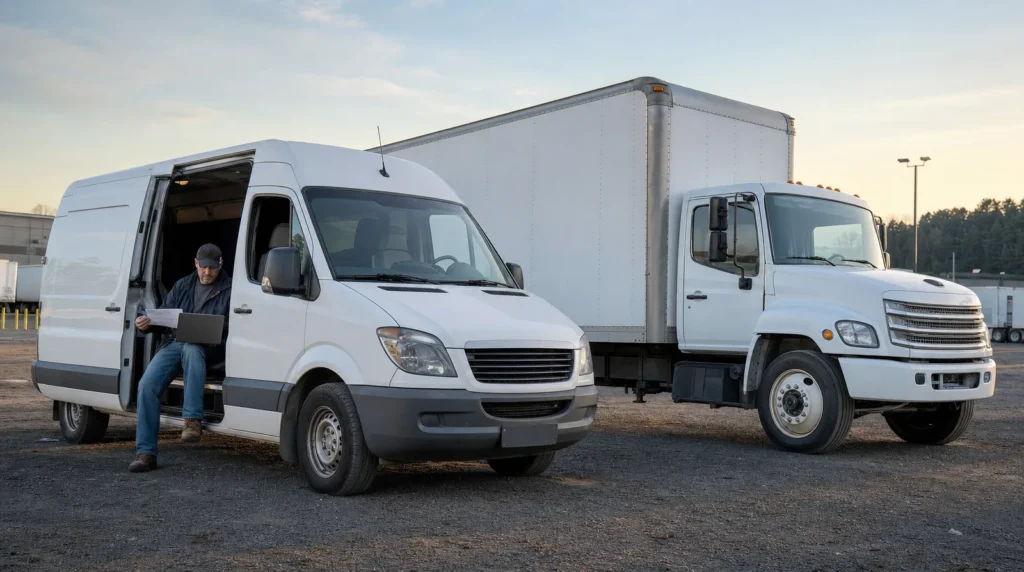
If you drive under another carrier’s authority on a long-term lease, the truck is counted in that carrier’s fleet and that carrier files. A cargo van under 10,001 pounds does not escape UCR if the business holds an MC number: the business still registers, normally in the lowest bracket. The rest of this guide walks through who files, what it costs, when to do it and what happens if you skip it, with links to the rule text so you can check the wording yourself.
Who has to register
The program is set up by federal law in 49 U.S.C. 14504a. FMCSA’s latest fee rule, published in the Federal Register on September 1, 2026 (91 FR 56063), sums up who pays: the UCR Plan and “the 41 States participating in the UCR Agreement assess fees to be collected from motor carriers, motor private carriers of property, brokers, freight forwarders, and leasing companies.”
For a small trucking business, the question is whether you operate in interstate commerce under your own USDOT and MC numbers. If you do, you are a registrant. The UCR Handbook that the UCR Board publishes also says there is no shortcut for a carrier that crosses state lines only now and then: “UCR offers no such arrangements” for trip permits, and the fee is “the same for a year or for part of a year. They are not pro-rated.” A business that starts interstate work in November still owes the full fee for that year.
A carrier that only runs inside one state is a different case. Under 14504a(j), a state “may elect to apply the provisions of the UCR agreement” to carriers that “operate solely in intrastate commerce within the borders of the State.” So if you never leave your state, check with your state’s UCR agency before you assume either way.
A cargo van under 10,001 pounds
This is the question we hear most from cargo van and Sprinter owners. UCR fees are counted by commercial motor vehicles, and under 49 U.S.C. 31101 a property-carrying commercial motor vehicle is one that “has a gross vehicle weight rating or gross vehicle weight of at least 10,001 pounds”. Many cargo vans are rated below that.
That does not take the business out of UCR. The UCR Handbook covers it directly. For carriers that run only vehicles that are not commercial motor vehicles, it says: “Such a business must register for UCR because it is one of the types of business covered by the program, but it would ordinarily pay a UCR fee in the lowest bracket because it operates no commercial motor vehicles.”
So a van-only carrier with its own MC registers and, in the normal case, pays the bracket 1 fee. Two details can change that. The statute lets a for-hire carrier choose to count lighter vehicles in its fleet. And the registration compliance helper on the UCR Plan site adds that “If these lightweight vehicles pull trailers in interstate commerce and the gross combination weight rating or gross combination weight is 10,001 or more, the entity will account for all of these commercial motor vehicles and pay the applicable fee.” A van with a trailer can cross the line even when the van alone does not.
What it costs in 2026 and 2027
Fees are set per entity by bracket, based on the number of commercial motor vehicles owned or operated. The 2026 fees are the 2025 structure kept for another year. The 2027 fees come from the September 2026 final rule, which is effective October 1, 2026. FMCSA describes the change as an increase that “averages 20 percent” over the 2025 and 2026 fees, and notes that the 2027 fees “will still be lower than those in effect during registration years 2019 through 2022.”
| Vehicles (bracket) | 2026 fee | 2027 fee |
|---|---|---|
| 0 to 2 (B1) | $46 | $55 |
| 3 to 5 (B2) | $138 | $167 |
| 6 to 20 (B3) | $276 | $333 |
| 21 to 100 (B4) | $963 | $1,163 |
| 101 to 1,000 (B5) | $4,592 | $5,548 |
| 1,001 and above (B6) | $44,836 | $54,165 |
Source: Table 1 to 49 CFR 367.40 and Table 1 to 49 CFR 367.50 in the 2026 final rule. Brokers and leasing companies pay the bracket 1 fee, $46 for 2026 and $55 for 2027.
For most owner-operators with their own authority, the number that matters is the first row. One to two trucks or vans means $55 for 2027.
Rather not run your own filings yet?
Apply with Suntrans and choose your path on the form: run under SuntransExpress authority, or keep your own MC and haul our freight.
When to register
UCR runs on the calendar year. The UCR Handbook says the Board has recommended that states open registration for a year “on the October 1 preceding the beginning of that year”, and that a carrier “must complete its UCR registration and pay its UCR fee before January 1 of the registration year. After that date, the registration fee is still due, but a nonregistrant may then be subjected to state enforcement action unless the UCR Board has postponed the due date for that year.”
For 2027, that window is open now. The UCR Plan’s registration site, ucr.gov, announces that “The 2027 UCR Registration is now open!” A simple habit works: renew in October or November, when the window opens, and keep the receipt with your other authority paperwork.
A new carrier does not wait for October. The Handbook says the fee “is due the moment the registrant self designates interstate commerce on their U.S. DOT profile”. If you are setting up your own authority this year, add UCR to the list alongside insurance and your process agent. Our guide to getting your own MC authority covers the other steps.
How your trucks are counted
The bracket depends on the count, so it is worth knowing which vehicles go in. Under 49 U.S.C. 14504a(f), a vehicle counts if it is registered in the carrier’s name “or is controlled by the motor carrier, motor private carrier, or freight forwarder under a long term lease during a vehicle registration year.” The count is based either on the number on your latest MCS-150 or on the number you owned or operated in the 12 months ending June 30 before the registration year.
The UCR Handbook fills in the lease part: “A long-term lease is one of thirty days or more. Trip leases, less than thirty days, are commonly referred to as rentals.” It also says what happens when one truck appears under more than one number: “if a vehicle is operated under more than one DOT number, it must be counted in each of the fleets associated with those numbers.”
Two practical points follow. Count the truck in whichever fleet it runs under on a long-term lease. And if you hold your own DOT number but lease your truck to another carrier for long periods, the truck may count in both fleets, so check your own MCS-150 numbers before you pick a bracket.
Own MC versus running under a carrier
This is where the answer to “who files” changes.
You have your own MC and USDOT. Your business is the registrant. You file UCR every year in your base state and pay the fee for your bracket, even if all your loads come from one carrier or broker. Having a steady customer does not move the filing to them.
You run under a carrier’s authority. When your truck is leased to a carrier long-term and you haul under that carrier’s MC and USDOT, the Handbook’s rule puts the vehicle in that carrier’s fleet. The carrier counts it and pays the fee for its fleet. You do not open a separate UCR registration for work done under its authority.
If you are unsure which side you are on, ask whose operating authority the load moves under. If it is the carrier’s, the truck sits in that carrier’s fleet count. If it is yours, the registration is yours.
Where to file and the base state
UCR is a base-state program. The Handbook explains that every business subject to UCR “deals for UCR purposes only with the state in which it is based”, which is usually the state where the business has its principal place of business. If your home state does not take part in UCR, the Handbook gives rules for choosing a participating state as your base.
The Handbook says a registrant “may choose to enter its information on the required registration form on-line”, and the UCR Plan’s national registration site is ucr.gov. If a company offers to file for you, ask what it charges on top of the fee and compare the total with the bracket fee in the table above.
What happens if you skip it
The fee stays due after January 1, and enforcement is handled by the states. Under 14504a, nothing stops a participating state “from issuing citations and imposing reasonable fines and penalties” on a carrier that fails to pay. Amounts vary by state, so there is no single national penalty figure.
The UCR Handbook also describes how states find carriers that have not paid. Some states tie vehicle registration to UCR, states audit a share of registrants against their fleet records, and “enforcement officials at all levels may access data bases of the FMCSA in order to ascertain whether an entity associated with a particular DOT number has a current UCR registration.” A carrier found to have underpaid “will be treated as if it has not registered”. For a small carrier, filing in October or November takes the question off the table. It also helps to have this paperwork in order before your new entrant safety audit.
FAQ
I only drive a cargo van under 10,001 pounds. Do I need UCR? If your business holds its own MC number and works interstate, yes. It normally pays the lowest bracket fee, $55 for 2027, because the van is not a commercial motor vehicle. If you run under another carrier’s authority, that carrier’s registration covers the work.
How much is UCR for one truck in 2027? $55. Bracket 1 covers zero to two commercial motor vehicles.
When is the 2027 deadline? Registration opened October 1, 2026, and it should be completed and paid before January 1, 2027.
I got my authority in November. Is the fee reduced? No. The Handbook says UCR fees are not pro-rated, so a carrier that starts late in the year pays the full fee for that year.
I’m leased to a carrier. Do I file UCR? If you haul under that carrier’s MC and USDOT on a lease of 30 days or more, your truck counts in its fleet and it files. If you also hold your own DOT number, the truck may count in your fleet too.
Does UCR replace IRP or IFTA? No. The Handbook says the UCR program “in many respects resembles” those programs, since all three are base-state programs, but UCR is its own registration with its own fee.
What this looks like at SuntransExpress
SuntransExpress works with cargo van, Sprinter and box truck owner-operators on both paths. On our owner-operator page you can run under SuntransExpress authority or keep your own MC and haul our freight. Owner-operators get weekly pay and 24/7 dispatch support.
How UCR works on each path:
- Without your own MC. You run under SuntransExpress authority, MC984362 and USDOT 2889264. Under the Handbook rule above, a truck leased to a carrier counts in that carrier’s fleet, so you do not file a separate UCR registration for that work.
- With your own MC. You haul our loads under your own authority, so your business keeps its own UCR registration current every year, as described above.
The application asks for your equipment type, the vehicle year and whether you have your own authority, so you can tell us which path fits. If you are weighing the two paths for a van, our guide to starting a Sprinter van business lays out the costs. Questions before you apply can go to hr@suntransexpress.com or +1 (941) 337-52-33.
Got questions about running with us? Dispatch will walk you through it. No pressure, no obligation.
Talk to us
Recourse vs Non-Recourse Freight Factoring
How freight factoring works for van and box truck owners on their own MC, what recourse and non-recourse really cover, and the contract clauses…
Read the guide →
Rate Confirmation: What to Check Before You Haul the Load
A four-pass check of a broker's rate confirmation for van and box truck owners with their own MC: the sender, the load, the money…
Read the guide →
Lumper Fees: Who Pays, and How Owner-Operators Get Reimbursed
Who owes a lumper fee under federal law, how it gets paid at the dock, and the receipt and paperwork you need to get…
Read the guide →Ready to get on the road?
Weekly pay, 24/7 dispatch support, and nationwide expedited loads, with or without your own MC authority.