Cargo van, sprinter or box truck: choosing your first unit
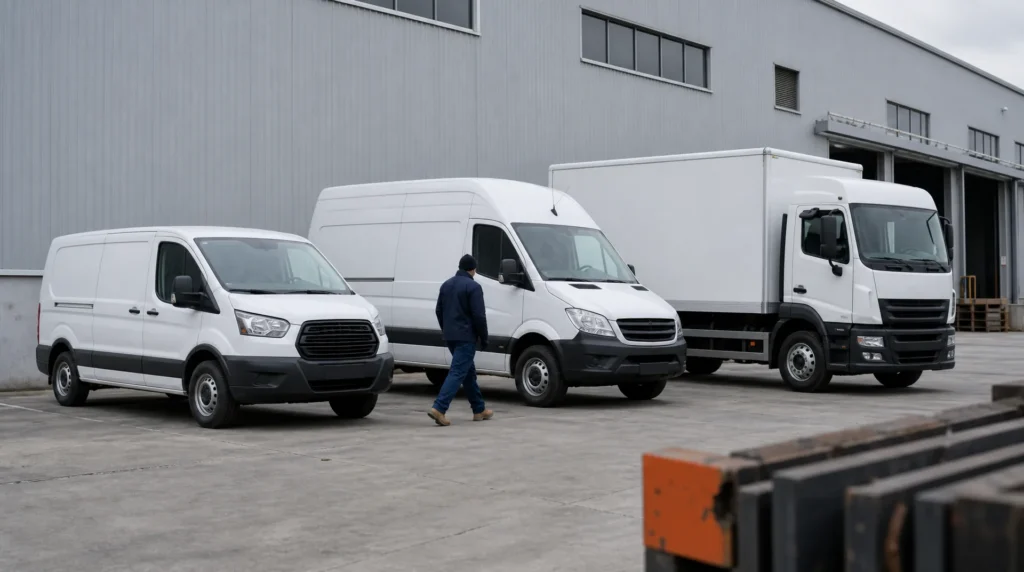
Your first unit sets your cost base for years. It decides which loads you can take, what your fuel bill looks like, and how much of a quiet week you can absorb. Here’s how the three units that carry most expedited freight actually compare — and how to pick between them.
Cargo van
The cheapest way into expedited freight and the easiest to keep running. A cargo van carries roughly 1,500–3,000 lb and up to three standard skids. It goes anywhere a car goes, needs no special endorsement, and the fuel bill stays modest on the long runs that make expedited pay.
What a van gets you beyond the low purchase price is flexibility. It parks in a city, it fuels at a normal pump, it clears a low dock canopy, and it is serviced by any decent shop rather than a truck-specific one. The downside is the ceiling: once a shipment is over about three skids or needs a liftgate, the load goes to somebody else.
Best for: a first unit, an operator who wants to learn the business before committing capital, and anyone who values a low fixed cost over a high rate.
Sprinter
A high-roof sprinter takes the same loads standing up — pallets no longer have to be broken down and stacked flat. It also opens up loads that need a liftgate or an e-track system. Purchase and maintenance cost more than a van, and that difference only pays back if you stay loaded.
The sprinter is the workhorse of expedited freight for a reason: it sits exactly where the freight is. Most time-critical shipments — a pallet of automotive parts, a temperature-sensitive medical shipment, a crate of trade show hardware — fit a sprinter without being big enough to justify a box truck. It also lets you stand up inside to secure a load properly, which matters more than it sounds when the customer’s freight is fragile and the clock is running.
Best for: an operator with some experience who wants access to the widest slice of the expedited board.
Box and straight truck
A 24-ft box truck moves 8,000–12,000 lb and up to twelve skids. The freight is bigger, the rates are higher, and so is everything else: DOT numbers, logbooks, tolls, tires. This is a second unit for most operators, not a first one.
Above 10,001 lb GVWR you are in federal territory — DOT number, hours of service, and the inspection regime that comes with them. Above 26,001 lb you need a CDL. Tires cost several times what van tires cost, a brake job is a different order of magnitude, and tolls are charged by axle. None of that is a reason to avoid a box truck; it is a reason not to buy one before you know your weekly load count.
Best for: an operator with a proven lane and enough volume to keep twelve skids’ worth of capacity moving.
Quick comparison
| Unit | Payload | Typical skids | CDL | Running cost |
|---|---|---|---|---|
| Cargo van | 1,500–3,000 lb | up to 3 | No | Lowest |
| Sprinter | 3,000–4,500 lb | up to 5 | No | Moderate |
| Box truck | 8,000–12,000 lb | up to 12 | Over 26,001 lb GVWR | Highest |
Treat the payload figures as a planning range, not a spec sheet — actual capacity depends on your GVWR, your curb weight, and how much you have added to the truck. Weigh your unit empty once and write the number down; it is the only payload figure that is really yours.
Not sure which unit the freight in your area actually calls for? Ask dispatch before you buy.
The costs that decide it
Purchase price is the number everyone compares and the least important one. Over a year, four other lines move more money:
- Fuel. A van at 18 mpg and a box truck at 9 mpg are two different businesses on the same run.
- Insurance. Premiums scale with unit class and cargo value, and the jump from van to box truck is steep.
- Maintenance and tires. Budget a fixed amount per mile from week one instead of paying for it out of one settlement.
- Downtime. A payment on a truck that sits three days between loads is the most expensive thing on this page.
New or used
Our requirement is a model year within the last ten years, which leaves plenty of room on the used market. A well-kept used unit with service records almost always beats a newer one with none. Whatever you look at, get it inspected by someone who is not selling it to you, and check the three items that turn a good week into a bad one: tires, brakes, and the emissions system on a newer diesel.
What to buy first
Buy the unit you can keep loaded, not the biggest one you can finance. An operator running a paid-off van every week out-earns one making payments on a box truck that sits three days between loads.
If you are starting from zero, a cargo van or a sprinter is almost always the right first unit. You learn the lanes, the customers, and your own numbers at the lowest possible fixed cost, and you can move up once you know what your board actually looks like. Once you have that picture, see what owner-operators earn on expedited freight for the cost lines behind the rate, and whether you need your own MC authority before you scale.
Ready to run? Start the owner-operator application.
Quick FAQ
Do I need a CDL for a box truck?
Only above 26,001 lb GVWR, or if the load is placarded hazmat. Plenty of 24-ft box trucks are specified under that line. Read the door sticker, not the box length.
Is a liftgate worth it?
On a sprinter or box truck, usually yes — it opens up shipments to sites without a dock, which is a large share of expedited delivery points. It costs payload and maintenance, so treat it as a decision about the freight you want, not an upgrade for its own sake.
Can I start on a van and move up later?
That is the normal path. Learn on the cheapest unit to run, keep the maintenance reserve, and buy the bigger truck once you can point at the loads that will fill it.
Got questions about running with us? Dispatch will walk you through it — no pressure, no obligation.
Talk to us
How to become an owner-operator with SunTransExpress
What you need to lease on, how long the paperwork takes, and what the first week of dispatch looks like.
Read the guide →
Do You Need Your Own MC Authority to Drive Owner-Operator?
You can run under your own MC authority or under a carrier's. Own authority means full control and the full compliance load; running under…
Read the guide →
What owner-operators actually earn on expedited freight
How expedited rates are built, which costs eat the difference, and what separates the operators who earn from the ones who just drive.
Read the guide →Ready to get on the road?
Weekly pay, 24/7 dispatch support, and nationwide expedited loads — with or without your own MC authority.