Owner-Operator Fuel Cards: Which One Actually Saves You Money
The short answer
A fuel card saves you money in two ways that are easy to confuse. One is a discount off the pump price at stations inside a network. The other is a credit that shows up on your weekly invoice or settlement rather than at the pump. Both are real, but they are worth very different amounts depending on what you drive and where you fuel. If you run a cargo van or a Sprinter, most of your fuel goes into a regular gas station, not a truck stop, and a card built around a truck stop network will give you a smaller share of what it promises. Choose the card that matches where you actually buy fuel, then check the fees, then look at the discount.
What a fuel card actually is
It is a payment card restricted to fuel and, usually, to a defined set of stations. The issuer negotiates pricing with the station networks in bulk and passes some of that back to you. It is not a credit card in the ordinary sense, and most programs are not underwritten like one either. Some are prepaid, some extend short-term credit against your settlements, and some are attached to a factoring company that is already advancing money against your invoices.
The card also becomes your fuel record. Every transaction carries the date, station, gallons, price and often the odometer, which is the raw material for both your tax return and, if you run in more than one state under your own authority, your quarterly filings.
Retail minus, cost plus, and why the advertised discount is not the discount
Programs price in one of two ways, and the difference decides whether the headline number means anything.
Retail minus takes the station’s posted cash or credit price and subtracts a stated amount per gallon. It is easy to read and easy to verify. It is also only as good as the posted price, which means a large discount at an expensive station can lose to a small discount at a cheap one.
Cost plus starts from the station’s wholesale cost and adds a fixed margin. When the market moves, this is usually the better structure, because you are not paying a retail markup that widens whenever prices are volatile. It is harder to verify at the pump, and you generally only see what you saved on the invoice.
The number in the advertisement is nearly always the best case: a specific station, a specific week, a full tank. Ask the issuer for the average realised discount per gallon across their whole network in the states you run, not the headline. If they will not give you that number, that is information too.
The network question, and why it is different for vans
This is the part most fuel card comparisons get wrong for expedite operators, because most of them are written for Class 8 drivers.
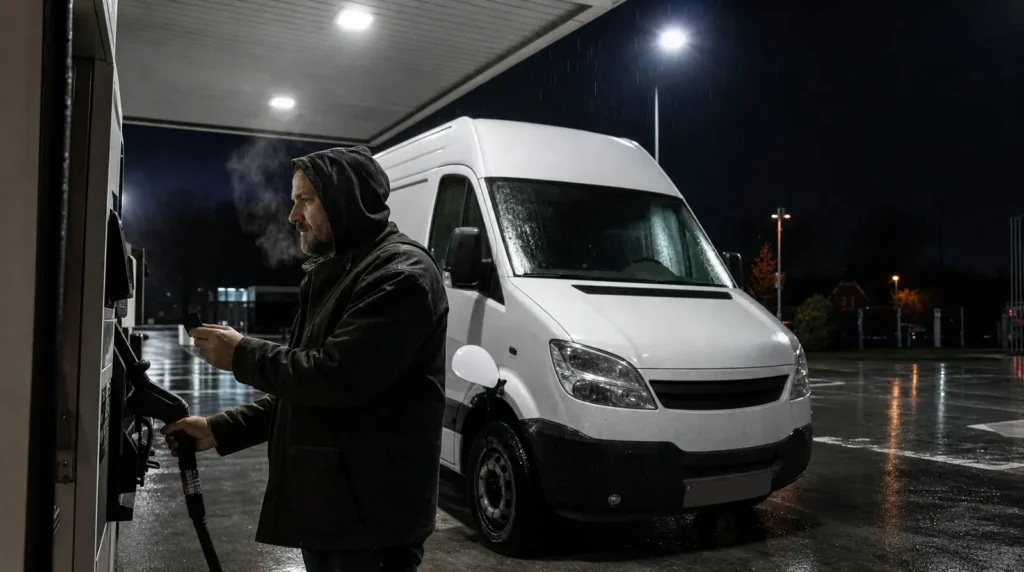
A tractor-trailer fuels at truck stops. Its driver has no realistic alternative, so a card tied to a large truck stop network covers close to 100 percent of that driver’s fuel spend. A cargo van or a Sprinter is a different animal. It fits under any canopy, it takes a fraction of the fuel, and the driver will often be standing at a station in a town with no truck stop within thirty miles. If your card only discounts inside a truck stop network, the portion of your fuel it touches might be half of what you buy, or less.
So before you compare discounts, do this: pull your last three months of fuel receipts and sort them by brand. That distribution is your actual requirement. A card with a smaller per-gallon discount across a broad retail network can beat a card with a large discount across a network you rarely use, and the receipts will tell you which one before you sign up for either. For more on how equipment choice cascades into running costs, see our guide on choosing your first expedited unit.
Running a Van? There’s Work for It.
SunTrans Express connects cargo van and sprinter owner-operators with companies that need their equipment. Weekly pay, nationwide.
Credit, prepaid, or tied to your factoring
Prepaid cards need no credit history and no business age. You fund them and you spend the balance. They are the easiest to get approved for, and they are the right answer in your first months. The cost is cash flow: money sits on the card instead of in your account.
Credit-based programs give you a line and bill you weekly or monthly. Approval usually looks at how long the business has existed, its authority status if it has one, and sometimes a personal credit check. New operators are frequently declined or given a small line that grows.
Factoring-linked cards deduct fuel from the invoices your factor is already advancing. If you are factoring, this is often the simplest structure, and it can come with a better discount because the issuer’s risk is covered by your receivables. The catch is that it locks you further into one factoring relationship, which matters if you later want to change. If you are still deciding whether you need any of this, our guide on running under your own authority or a carrier’s covers which costs land on you in each case.
The fees that eat the savings
Read this section of the agreement before you read the discount page. The common charges are a per-transaction fee, a monthly or annual account fee, a fee for cards beyond the first, an out-of-network transaction fee, an ATM or cash advance fee, and a fee for paper statements. A card advertising a strong per-gallon discount with a per-transaction fee attached is a bad deal for a van operator specifically, because a van fills more often and in smaller amounts, so a flat fee per fill is spread across fewer gallons every time.
Run the arithmetic on your own numbers rather than theirs. Take your average gallons per fill from those three months of receipts, multiply the promised discount by that figure, and subtract the transaction fee. If the result is close to zero, the card is a bookkeeping tool rather than a savings tool, which is still a legitimate reason to carry one.
What it does for your bookkeeping
The reporting is worth something on its own. A fuel card gives you a single clean feed of every fuel purchase, categorised, with the state each gallon was bought in. That feeds the fuel line of your tax return directly, and if you run interstate under your own authority it feeds your quarterly fuel tax filing without you keeping a shoebox. It also gives you a per-mile fuel cost you can actually trust, which is the number that tells you whether a rate is worth accepting. Our guide on what owner-operators actually earn on expedited freight works through where that number sits in the wider picture.
Quick FAQ
Which fuel card is best for owner-operators? There is no single answer, and any article that gives you one has not looked at your receipts. The best card is the one whose discount network overlaps where you already fuel, whose fee structure survives your average fill size, and whose approval requirements you meet today. For Class 8 drivers that is usually a truck stop network card. For cargo van and Sprinter operators it is often a broad retail network card instead.
What is the best fuel card for hotshot truckers? Hotshot operators sit between the two cases. A pickup pulling a gooseneck can use truck stop lanes but does not have to, so both card types are genuinely available. Compare on realised discount across your own last three months of stations rather than on the headline rate.
What is the easiest fuel card to get approved for? A prepaid card. There is no credit decision because there is no credit extended. If you are in your first year and have been declined for credit-based programs, start prepaid, build a payment history, and revisit in six months.
Can I get a fuel card with my EIN? Many programs will open an account against an EIN, but a new business with no history will often still face a personal guarantee or a prepaid structure. An EIN gets you in the door. Trading history is what removes the guarantee.
Running with SunTransExpress
We run cargo vans, Sprinters and straight trucks on expedited freight across the continental United States, and we work with owner-operators who bring their own unit. If you want to talk through what your fuel and running costs actually look like on our freight before you commit to anything, that conversation is free and we would rather have it early.
Call +1 (941) 337-52-33 or write to hr@suntransexpress.com.
Got questions about running with us? Dispatch will walk you through it — no pressure, no obligation.
Talk to us
New Entrant Safety Audit: What a First Year Carrier Gets Checked On
What the FMCSA new entrant safety audit checks in your first 18 months under your own authority, the 16 violations that fail it, how…
Read the guide →
Cargo Van, Sprinter and Box Truck Owner-Operator Jobs: What the Posting Leaves Out
What a cargo van, Sprinter or box truck owner-operator posting leaves out: pay basis, whose authority, insurance, escrow and charge-backs, deadhead and detention, and…
Read the guide →
Box Truck and Cargo Van Loads: Where Owner-Operators Find Freight
Where box truck and cargo van freight actually comes from: load boards and what their tiers include, posting your truck, checking brokers against the…
Read the guide →Ready to get on the road?
Weekly pay, 24/7 dispatch support, and nationwide expedited loads — with or without your own MC authority.